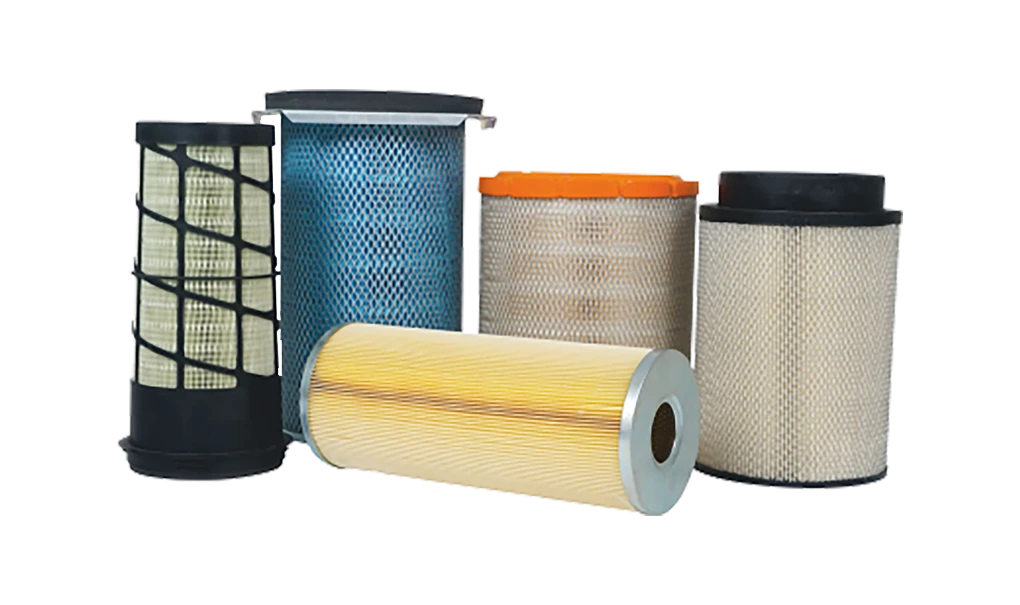
Air filters are an essential part of any HVAC system as they allow for the removal of particulate contaminants in the supply air that would otherwise be harmful to the filtration systems, or build up in the ductwork or equipment. They are an essential part of air moving devices such as terminal units, fan coils and air handlers as they remove dirt that would otherwise cause coil blockages and fan wheel imbalances.
There are two types of filters that are commonly used in air moving devices: • Panel filters • Extended surface filters. Panel filters are made using coarse, highly porous fibres coated with a viscous, sticky substance to increase particle impingement and detainment on the fibres. They rely on air straining and inertial impingement to capture contaminant particles. Panel filters are typically low cost and have low pressure drops, but they also have low cleaning efficiencies. They are generally used on terminal units and low-pressure fan coils. Extended surface filters use fibre mats of varying thickness, density, and fiber size in a frame to form pockets or pleats. This creates a higher surface-to-face-area ratio which reduces pressure drops and face velocities. These lower velocities allow for interception type particle capture, as well as air straining and inertial impingement. Pleated filters generally have higher efficiencies and lower pressure drops than panel filters, which is why they are used in larger capacity units such as blower coils and high-performance fan coils. Different applications require different levels of air cleaning effectiveness. When selecting a filter, the designer must consider several factors such as the type of contaminants present, the size and concentration of contaminants, and the level of air cleanliness required. They must also consider the system constraints such as available space, allowable airflow resistance, and system cost.
Air Filters